Salt Lake City musician and restless builder Fezmaster (a/k/a
Jon Philpott) focuses on generative ambient electronics,
bamboo flute, wind synth and trombone performed live and primarily
improvised. Builder of the instruments he plays: custom effects
pedals, synthesizers, large-scale PureData and Supercollider
patches driven by cellular automata and other stochastic
processes: tipping the sonic dominoes, impermanent and empty,
music for "nostalgia of something you weren't there for, a
feeling of deja vu for something you don't remember
experiencing."
an improvised ambient music performance rooted in buddhist philosophy with custom-made electronics and acoustic instruments
The three marks of existence are a concept in all Buddhist traditions, they are:
It’s said that all conditioned things bear these three marks. 3marks is a musical performance that is built upon these three marks: all audio created and processed during the performance is constantly being reproduced imperfectly, is fundamentally impermanent, and is all built from other elements and therefore lacks a unique, permanent self-identity.
Tibetan buddhist monks engage in a process of creating sand mandalas, intricate paintings made from powdered sands, and at the point of completion, the monks will destroy the image as a demonstration of the impermanence of all things. This performance is akin to a sand mandala of sound; an intricate soundscape and composition is built, piece by piece and then is blown away by the process of degradation provided by virtual tape machines. Sand mandalas are constructed with an almost fractal nature, with repeated and nested motifs, occurring at different sizes and scales and variations. The performance progresses in a similar fashion, with improvised motifs being captured, repeated, recombined and nested within different sized tape loops, where a careful listener could trace each sound back to its original origin.

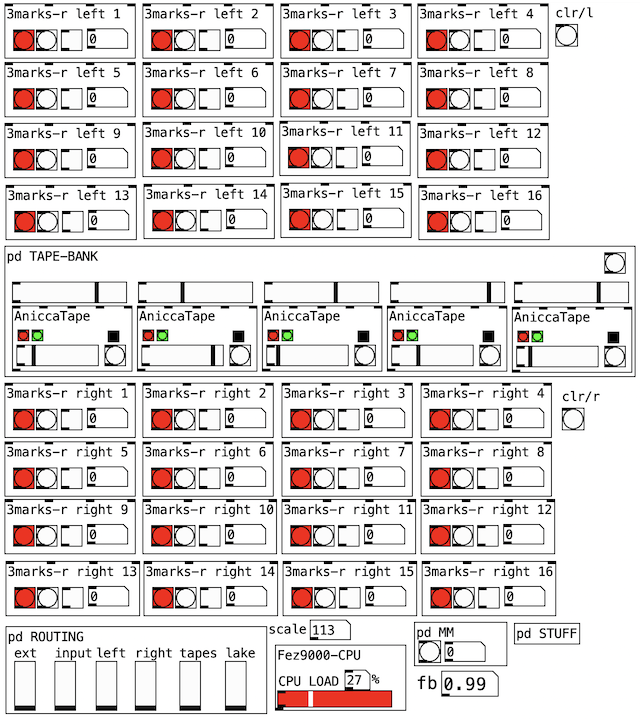
The performance uses a system, built on Pure Data that creates three racks of virtual tape machines, 36 machines in total, running in loops each with a variable length of tape. Each of these tapes goes through a constant process of degradation — providing the imperfection of dhukka, as parts of the audio get lost or dimmed, they get noisier and distorted and eventually dissolve into a low, familiar hiss, fundamentally impermanent. As I perform with a wind synth and bamboo flutes, I can record it’s audio into one or many of the tapes in the first rack, and the subsequent combination of all the tape machines playing in the first rack can then be sent into tapes into the second and third racks and amongst themselves. Each time pieces of the audio are recorded into another machine, they’re recorded with their imperfections and will then begin to dissolve themselves; this can create a situation where there’s a sound, or sequence of notes that I might want to hold onto, but the very act of trying to cling harder to it by recording additional copies of it only results in it’s further degradation.
Each of the tape machines in the system acts like a jewel within Indra’s Net, another image from buddhism: imagine an infinitely sized net and at each intersection is a faceted jewel that reflects the image of every other jewel and is itself reflected amongst other jewels; each jewel’s appearance is interconnected and is a combination of others. In the same way, during this performance each tape machine is reflecting the sounds from my playing or the other tape machines.